Rochester Institute of Technology News
Imaging Science Ph.D.
-
May 8, 2023
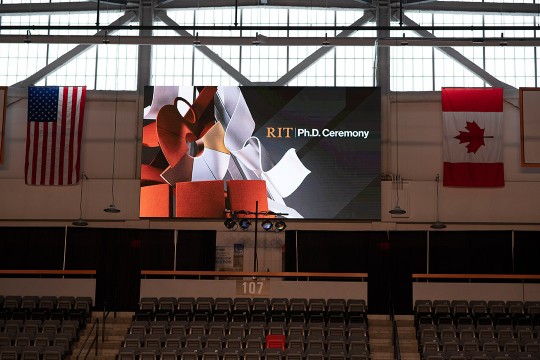
RIT to award record number of Ph.D. degrees
RIT will confer a record 69 Ph.D. degrees during commencement May 12, marking a 53 percent increase from last year.
-
May 4, 2023

RIT scientist helps explore mysterious shadow play around planet-forming disk
Professor Joel Kastner from RIT’s Chester F. Carlson Center for Imaging Science and School of Physics and Astronomy is part of a team of scientists using the Hubble Space Telescope to study how the changing patterns of shadows cast on the dusty disks orbiting young stars can reveal the presence of newly formed planets.
-
April 29, 2023
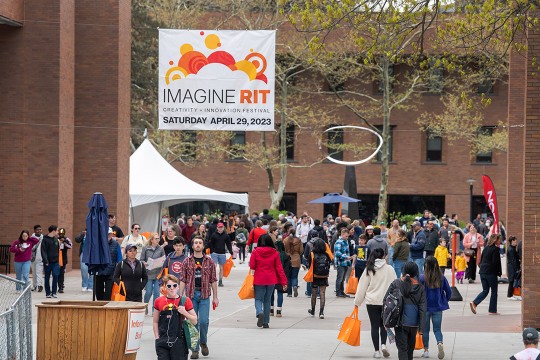
Imagine RIT festival proves the future is bright
Thousands of visitors at the 2023 Imagine RIT: Creativity and Innovation Festival got to see what’s on the horizon in the areas of technology, the arts, and design. Festivalgoers traversed RIT’s campus on Saturday, exploring more than 350 exhibits.
-
April 6, 2023

Gift from alumnus Steve Wear will support RIT’s imaging science students and drone lab
A gift from an RIT distinguished alumnus, Steve Wear '91 (imaging science), will help RIT students and researchers reach new heights on the frontier of imaging science.
-
March 22, 2023

Eyes on the bigger picture
The Business Standard features Manisha Das Chaity, an imaging science Ph.D. student.
-
February 1, 2023
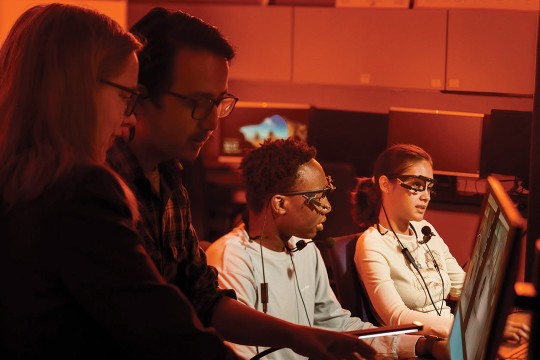
Doctoral offerings keep growing
RIT is growing its Ph.D. offerings, adding one new program in the fall of 2023 and two in 2024. This fall, Saunders College of Business will offer a Ph.D. in business administration. In 2024, the College of Liberal Arts will introduce a new doctoral degree in cognitive science and the College of Science will launch a Ph.D. in physics.
-
January 16, 2023

RIT scientists help rediscover earliest known star map using multispectral imaging
Scientists uncovered what they believe to be the first astronomical map. The discovery, outlined in recent studies published in the Journal for the History of Astronomy and the Classical Quarterly, was made in part thanks to multispectral imaging conducted by researchers at Rochester Institute of Technology’s Chester F. Carlson Center for Imaging Science.
-
January 9, 2023

James Webb Space Telescope study reveals wide diversity of galaxies in the early universe
New data from the James Webb Space Telescope (JWST) have revealed that the structures of galaxies in the early universe were much more diverse and mature than previously known. RIT Associate Professor Jeyhan Kartaltepe said that JWST’s ability to see faint high redshift galaxies in sharper detail than Hubble allowed the team of researchers to resolve more features and see a wide mix of galaxies.
-
October 11, 2022
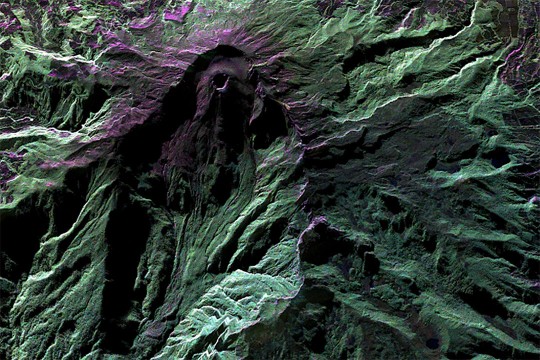
RIT researcher receives Department of Energy grant to develop synthetic aperture radar technology
James Albano, a researcher/engineer at RIT’s Chester F. Carlson Center for Imaging Science, has launched a project funded by the Department of Energy to develop remote sensing technology that could have applications ranging from assessing earthquake damage to determining soil moisture for predicting crop yield.
-
July 18, 2022

RIT will begin offering two new Ph.D. programs in fall of 2023
RIT will begin offering two new Ph.D. programs beginning in the fall of 2023: business administration and cognitive science. Today, RIT enrolls 300 students in 11 Ph.D. programs.
-
July 12, 2022

Ph.D. student applies imaging science to preventing disasters
Kamal Rana, an imaging science Ph.D. student from India, has been using his skills to help identify landslide triggers and develop models for forecasting landslides.
-
June 6, 2022
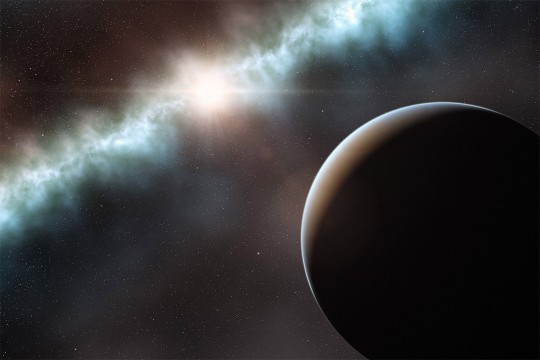
RIT professor earns NASA grant to study baby stars and newborn planets closest to Earth
A team of RIT scientists is poring over NASA data for new insights about Earth’s youngest, closest neighbors. Joel Kastner, a professor in RIT’s Chester F. Carlson Center for Imaging Science and School of Physics and Astronomy, received nearly $400,000 for a NASA archival study to advance our understanding of newly formed stars and planets.