RIT students across disciplines create peacebuilding video game
Students and faculty aim to use digital games to build peaceful futures after war
Peaceland
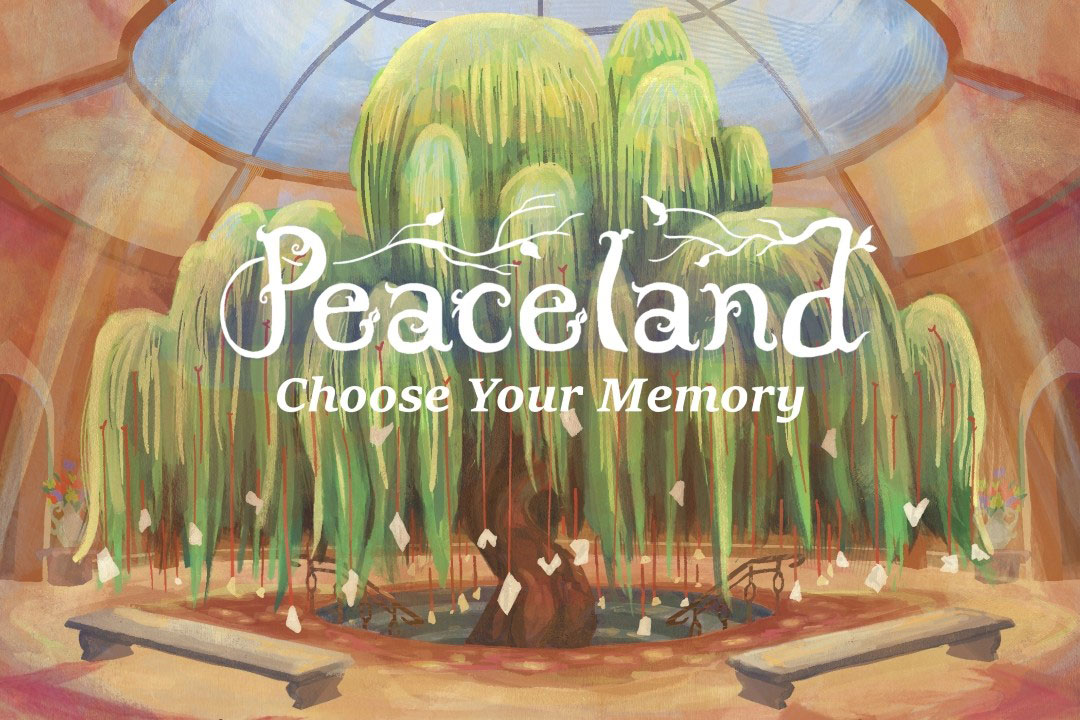
A team of RIT students and faculty are developing Peaceland, a video game for peacebuilding. Players in the game conduct five interviews to collect war memories at the opening of a new museum exhibit called the Memory Tree.
Small choices can have big consequences. That’s the idea at the heart of Peaceland: Choose Your Memory, a new video game being developed by students and faculty at Rochester Institute of Technology.
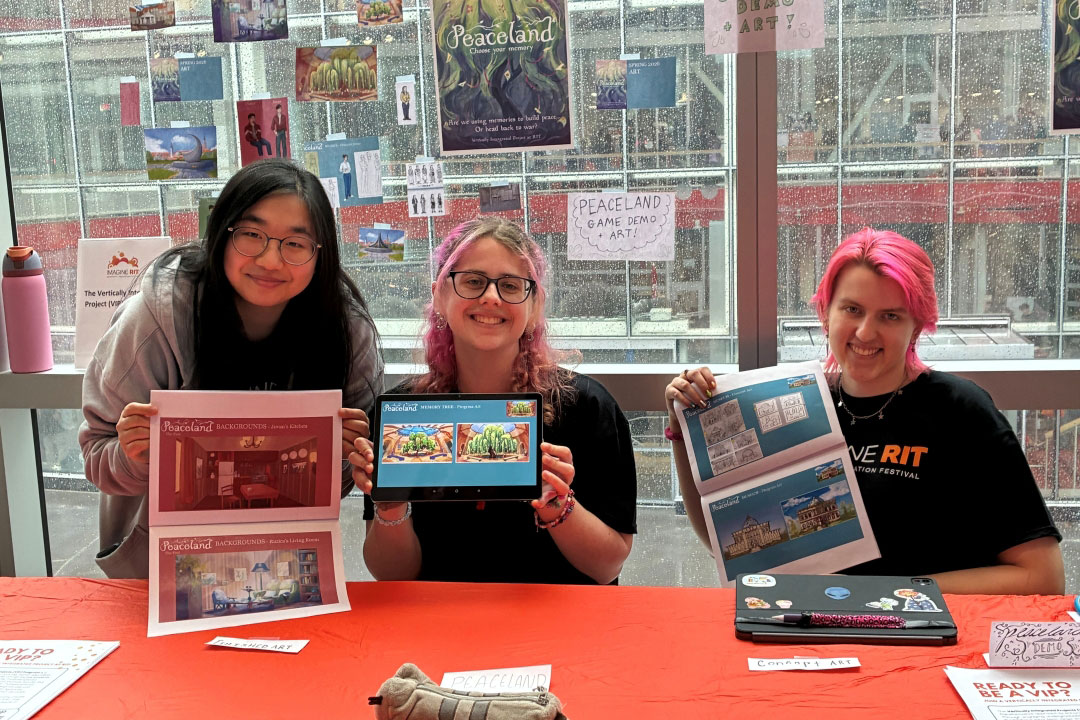
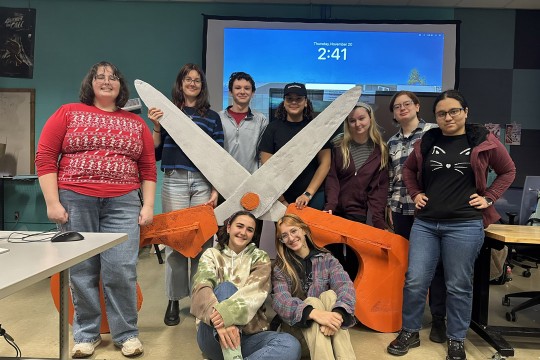
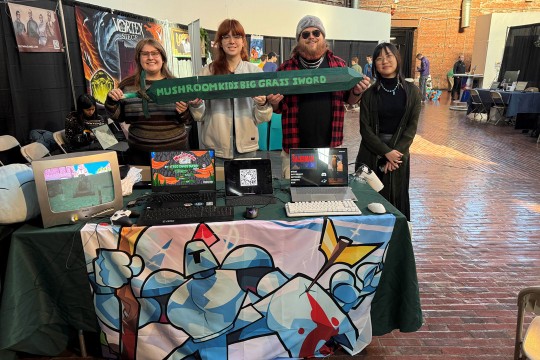
New students join the Peaceland team each semester. The Spring 2026 Art Team, including Tori Wong, left, Zosia Rosler, Alyssa Ebert, and Leah Leupold (not pictured), presented the game at Imagine RIT 2026.
Set in a fictional country, 30 years after war, Peaceland asks players to consider how the memories of conflict influence the present. The game draws from real-life experiences to disrupt divisive narratives about the past and motivate players to build peaceful futures.
“The game doesn’t judge or tell people what to do,” said Marcia Hartwell, professor of practice in RIT’s School of Individualized Study and a faculty leader on the game. “You learn as you make decisions throughout the game and the small choices you make scale up to peace, war, or something in between.”
“Everyone has agency, especially young people,” she said. “You have a voice, and your voice matters.”
For the dozens of RIT students developing Peaceland, the project offers something beyond experience making a video game. It is a chance to explore how their skills can be used to address a difficult real-world issue. They are also earning academic and co-op credit, while learning to research, develop narrative, illustrate, design, program, ad incorporate feedback from playtests with local and international players.
When the creators publish the game, they see it reaching audiences beyond RIT.
Hartwell said the project has applications in serious, transformative, social impact games and in PeaceTech, an emerging field that uses data and digital tools to prevent conflict and reduce violence. She sees Peaceland being used by the United Nations and other locally-led organizations working toward peace.
Why design a game to build peace?
The game follows a 20-year-old member of a post-conflict generation living in a country recovering from civil war. After entering a museum, players encounter different characters and their memories, make choices about how to interact with others, and discover the consequences of those choices as the story unfolds.
One character for example, named Boris, wants to do good in the present, but has a challenging past as a paramilitary member in the war.
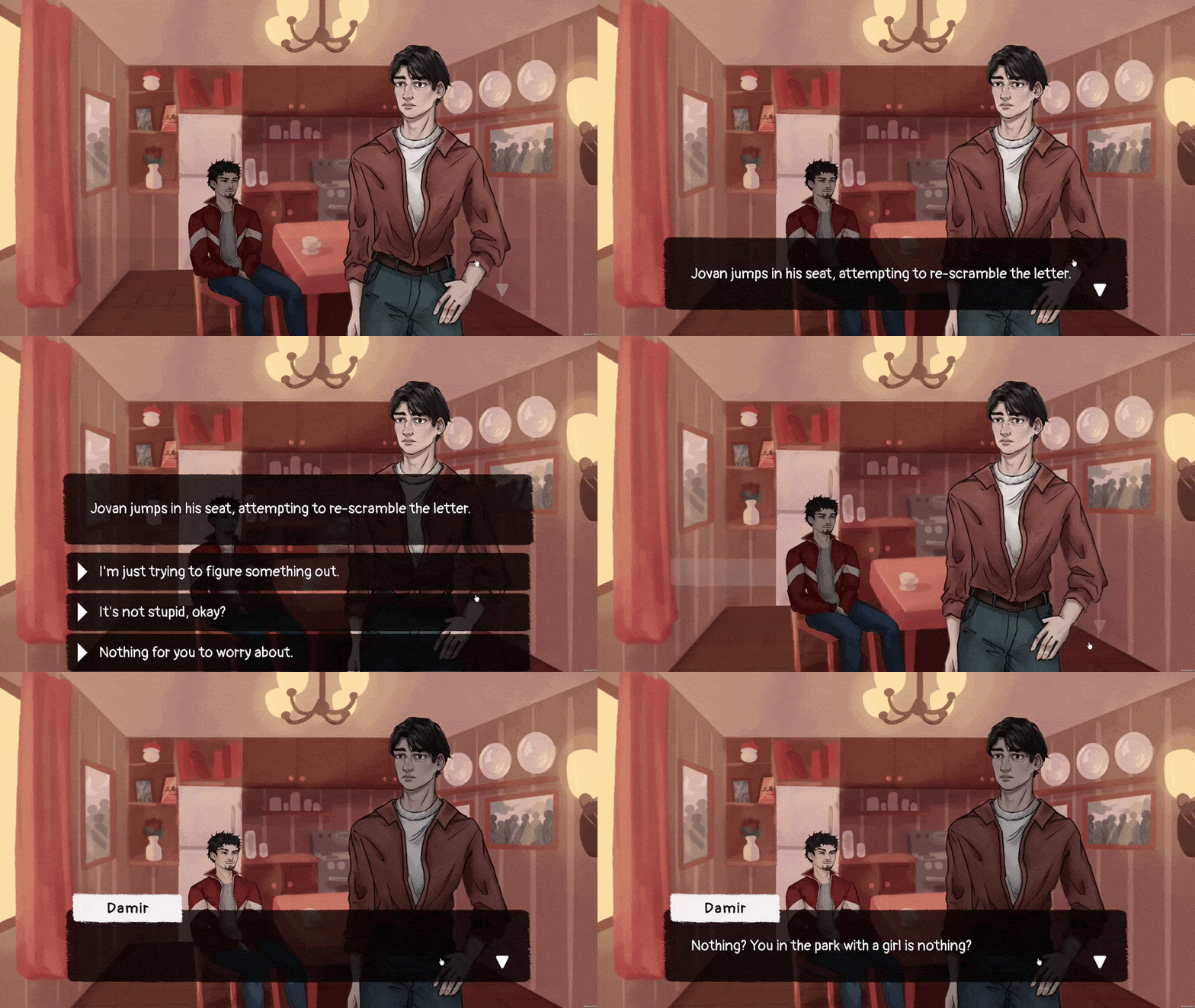
Ruzica and Jovan, a married couple whose families are enemies, share their memory of secretly running away with the help of Jovan's cousin Damir. In the game, player's act as a young museum volunteer named Marc and are immersed in the memory.
“Do you have to believe what everyone around you believes? Can you build a peaceful future with people you don’t like?” said Hartwell. “You don’t find out the outcome until the end of the game.”
The idea for the game grew out of Hartwell’s 2022-23 Fulbright Scholar experience in Kosovo, where she researched how digital technology can support peacebuilding with RIT Kosovo students. The country experienced an armed conflict in the late 1990s.
There, she saw how memories of war can continue to influence generations who never experienced the conflict themselves. Those memories can bring communities together, but they can also deepen divisions and be weaponized by politicians.
“You carry burdens of the past into the future,” said Hartwell. “Can you work with past enemies, or do you hate them and blame them?”
In Kosovo, she talked with students about why things were remembered and how to get people to remember in a more unbiased way. One idea that emerged was a digital game that could offer a way to engage with post-conflict issues other than with traditional structured dialogue.
The game combines narrative storytelling, minigames, and reflective moments to encourage players to think about the connections between the past, present, and the future.
Students create a game with purpose
Peaceland is being developed through RIT’s Vertically Integrated Projects program. This brings together students from different disciplines and allows them to work on the project across semesters.
For Bella Miller, a third-year game design and development major, Peaceland has provided a way to combine her interest in storytelling with her technical education.
“I always loved writing stories, and I normally work on fantasy things,” said Miller, who is from Alexandria, Va. “Now, every time I research narrative for this game, I learn something new.”
The game’s fictional setting draws inspiration from the conflicts in the Balkans. Keeping the story grounded in reality requires research into history, current events, characters, geography, and the effects of conflict on communities today. As the narrative lead, Miller’s responsibilities include researching visuals, developing characters, writing dialogue, and creating outlines, wireframes, and scripts.
“Having a shipped game with my name on it will be huge for getting a job in the games industry,” said Miller.
Kay Hutchins, a third-year illustration major, joined the project because she wanted experience working as an artist on a team. She was also drawn to the game’s focus on empathy and community.
“Community is something I’m really passionate about and I think it’s especially important to maintain connections that allow it today,” said Hutchins, who is from Buffalo, N.Y. “This project actively reflects that and I’m really glad to be part of it.”
Hutchins works as a 2D artist creating character portraits, backgrounds, and other visual assets for the game.
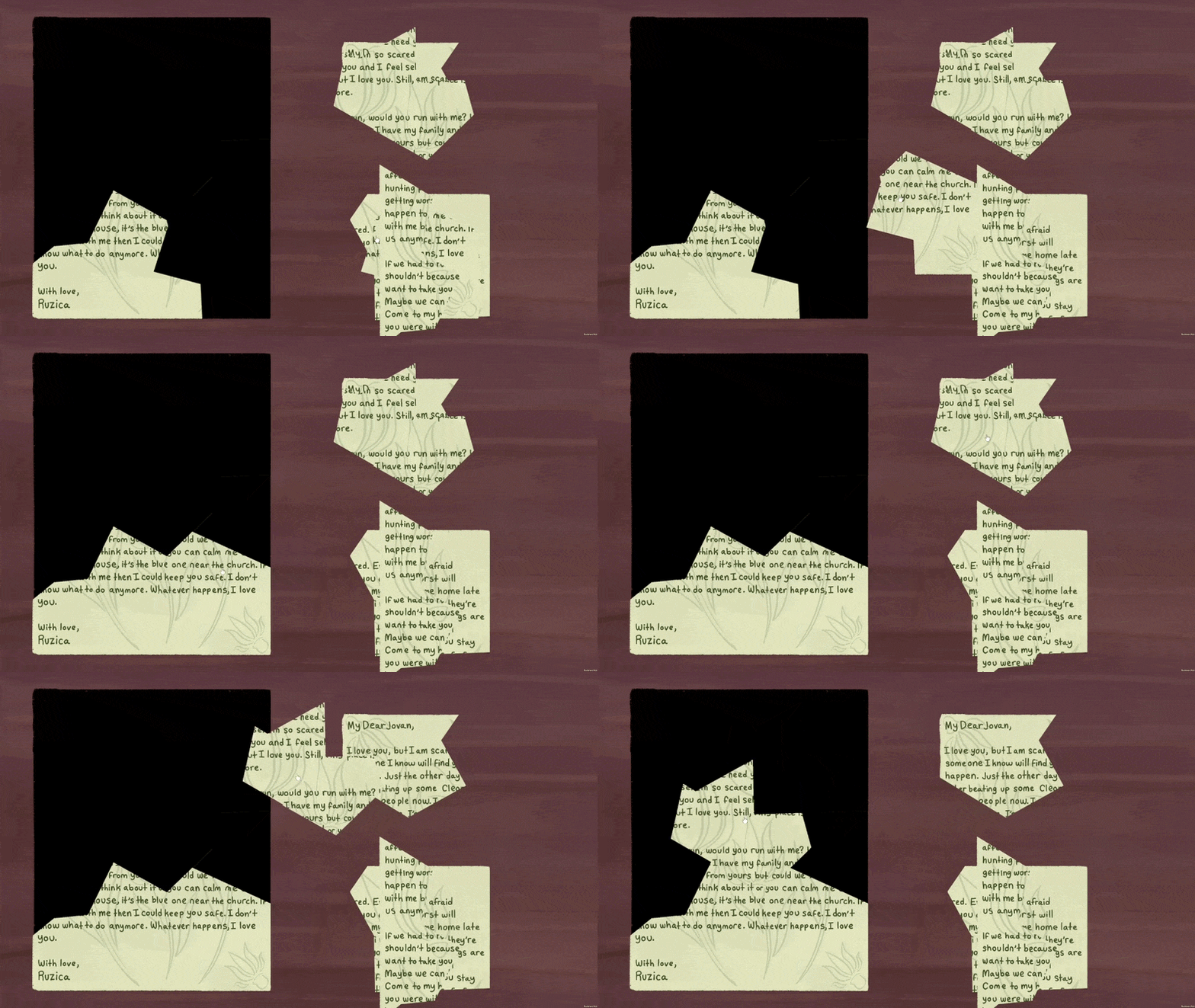
Game designers for the Peaceland project have created several minigames, including one where players assemble the pieces of a letter that Ruzica wrote to Jovan about running away together.
Experiential learning opportunities like Peaceland prepare students for career success and are a staple at RIT, which is ranked fifth among co-op/internship programs by U.S. News & World Report. The students work across development, narrative, and art teams, learning how to communicate across disciplines, give constructive feedback, and build on one another’s work.
The game began in 2024 and is currently in preproduction. RIT Kosovo students and University of Rochester students from Bosnia-Herzegovina and Serbia are consulting on the game. The team hopes to release Peaceland in 2028 as an open-access game for PC, web, and mobile platforms, with approximately three to four hours of gameplay.
Peaceland: Choose Your Memory Game Trailer