Personalized Healthcare Technology

Personalized Healthcare Technology integrates interdisciplinary research to tackle problems in unconventional ways, creating a new future in healthcare delivery and individually empowered health.
$1T
Estimated medical costs for cardiovascular disease by 2030
9
Colleges at RIT involved in personalized health care technology research
101
Combined years of experience in academia among six faculty mentors
Key Faculty


View full list of affiliated faculty
Related Degree Programs
- Applied and Computational Mathematics MS
- Applied Mathematics BS
- Applied Statistics MS
- Applied Statistics and Actuarial Science BS
- Bioinformatics and Computational Biology BS
- Bioinformatics MS
- Biomedical Engineering BS
- Biomedical Sciences BS
- Biotechnology and Molecular Bioscience BS
- Computational Mathematics BS
- Electrical Engineering BS
- Electrical Engineering MS
- Human-Computer Interaction MS
- Human-Centered Computing BS
- Microelectronic Engineering BS
- Microsystems Engineering Ph.D.
- New Media Interactive Development BS
- Health Systems Management MS
- Web and Mobile Computing BS
Related News
-
October 1, 2026

RIT student wins HackMIT with low-cost medicine testing device
An RIT student and his team took home the first-place grand prize at HackMIT 2026, the Massachusetts Institute of Technology hackathon.
-
September 30, 2026
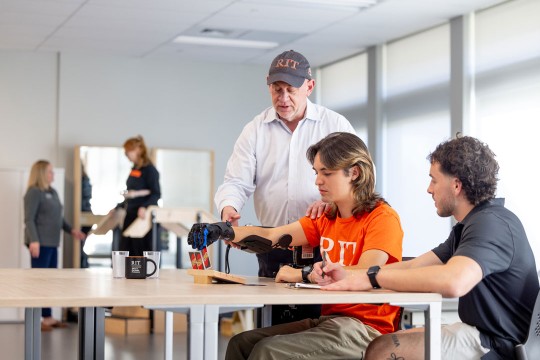
RIT’s occupational therapy program blends technology and patient-focused care
The future of occupational therapy is on display at RIT in a suite of cutting-edge laboratories that support RIT’s new doctorate in occupational therapy.
-
August 28, 2026
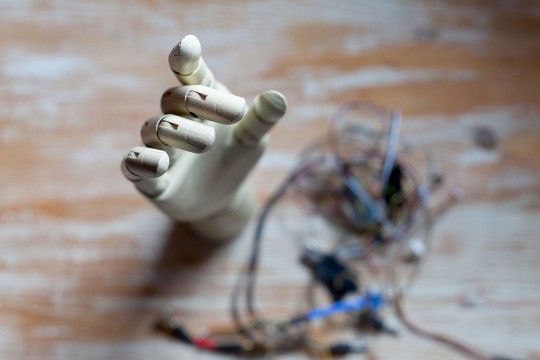
Bioprinting and smart sensors converge in new RIT prosthetic prototype
3D Printing Industry reports on RIT research combining bioprinting, hybrid materials, smart sensors, and mechanical design to create more customizable finger and hand prosthetics. The collaboration among researchers at RIT’s Rochester and Dubai campuses could lead to more affordable devices with improved movement and a functional sense of touch.
-
August 20, 2026

RIT Researchers Aim to Improve Prosthetic Devices with Bioprinting Breakthroughs and More
O&P Almanac highlights RIT research advancing 3D-bioprinted finger prostheses that combine flexible, biocompatible materials, smart sensors, and mechanical properties designed to enable more natural movement and a sense of touch.